
The System Is On. The House Is Still Hot.
Few things are more frustrating than watching the thermostat sit at 78 degrees while your AC runs continuously and accomplishes nothing. You can hear the system humming. You can feel air coming through the vents. But it’s not cool air, and the house is not cooling down.
We get calls about this constantly, especially once June arrives in Berks County. And the cause isn’t always obvious from the outside. There are at least half a dozen different reasons an AC unit can run without cooling, ranging from a simple fix you can handle in five minutes to a refrigerant leak that needs a licensed technician.
Let’s work through the most common culprits so you know what you’re dealing with.
Start With the Easy Stuff
Before you call anyone, check the air filter. Seriously. A clogged filter restricts airflow so severely that the system can’t move enough air across the evaporator coil to cool it properly. The coil ices over. The unit keeps running. Your house stays warm. Swapping in a clean filter sometimes fixes the problem entirely.
Also check every supply vent in the house. One closed vent in a spare room can throw off the entire system’s pressure balance. It sounds minor. It isn’t.
Look at your thermostat settings too. Make sure it’s set to COOL and not FAN ONLY. Fan-only mode circulates air without engaging the compressor. It’s a common accidental setting, especially in houses with newer programmable or smart thermostats.
If those three things are fine, then you’ve got a real problem, and it’s time to dig deeper.
Low Refrigerant Is More Common Than People Think
Refrigerant is the substance that makes cooling possible. It absorbs heat from your indoor air and releases it outside. When levels drop, the system loses its ability to transfer heat effectively. The air coming through your vents might feel slightly cool but nowhere near cold enough to drop the room temperature on a hot Pennsylvania afternoon.
Low refrigerant almost always means a leak. Refrigerant doesn’t burn off or get used up under normal operation. If it’s low, it escaped somewhere.
This is not a DIY fix. Refrigerant handling requires EPA certification, and the leak needs to be located and repaired before recharging. A technician who just adds refrigerant without finding the leak is wasting your money. The level will drop again.
The EPA’s refrigerant regulations page has useful background on why this work requires a licensed professional and what regulations govern refrigerant handling in residential HVAC.
A Dirty Condenser Coil Will Kill Your Cooling Capacity
The outdoor unit, the big box sitting on a concrete pad beside your house, has condenser coils that need to release heat to the outside air. If those coils are coated in a season’s worth of dirt, pollen, and debris, they can’t release heat efficiently.
The system keeps working. But it’s like trying to breathe through a wet cloth. The harder it works, the hotter the components get, and the less cooling actually reaches your living space.
You can gently rinse the outdoor unit with a garden hose from the inside out. But if the coils are genuinely packed with debris, that’s a job for a technician with proper coil cleaner and the right equipment. Don’t use a pressure washer. The fins on condenser coils are delicate and bend easily, which makes the problem worse.
The Compressor Might Be the Issue
The compressor is the heart of the system. It pressurizes the refrigerant and keeps the whole cooling cycle moving. When it fails or starts failing, you’ll often see the unit running but producing very little cooling effect.
Compressor failure is expensive. In many cases, especially on older systems, a failed compressor makes replacement of the entire outdoor unit the more financially sensible choice. A reputable technician will walk you through the comparison honestly, including the age of the unit, the cost of the repair, and the likely remaining life of the system.
We’ve had that conversation with homeowners many times. Sometimes repair makes sense. Sometimes it doesn’t. We give you the real numbers and let you decide. That’s how we think HVAC service should work.
You can learn more about how we approach diagnostics and repairs on our HVAC services page.
Ductwork Leaks Lose More Than You’d Expect
This one surprises people. If your ductwork has significant leaks, the cooled air your system produces might never reach the rooms you’re trying to cool. It escapes into your attic, your crawl space, or between your walls.
According to ENERGY STAR, the average home loses about 20 to 30 percent of its conditioned air through leaky ducts. That’s a massive efficiency loss, and it explains why some rooms stay hot even when the rest of the house cools down.
A technician can do a duct pressure test to identify significant leaks. Sealing those leaks improves comfort and cuts energy costs simultaneously.
Oversized or Undersized Systems
Here’s something most people don’t expect to hear: an AC unit that’s too big for your home can fail to cool properly.
Oversized systems cool the air too quickly, which sounds ideal until you understand the problem. The unit reaches the thermostat’s target temperature fast, shuts off, and never runs long enough to pull humidity out of the air. High humidity makes a room feel hotter than the thermometer says. The house feels clammy and uncomfortable even at 72 degrees.
Undersized systems have the opposite problem. They run constantly, never quite catch up, and burn out prematurely.
Proper sizing requires a Manual J load calculation that accounts for your home’s square footage, insulation levels, window area, orientation, and local climate data. If a previous contractor put in a unit without doing that math, the wrong size might be part of your problem.
When to Call Us
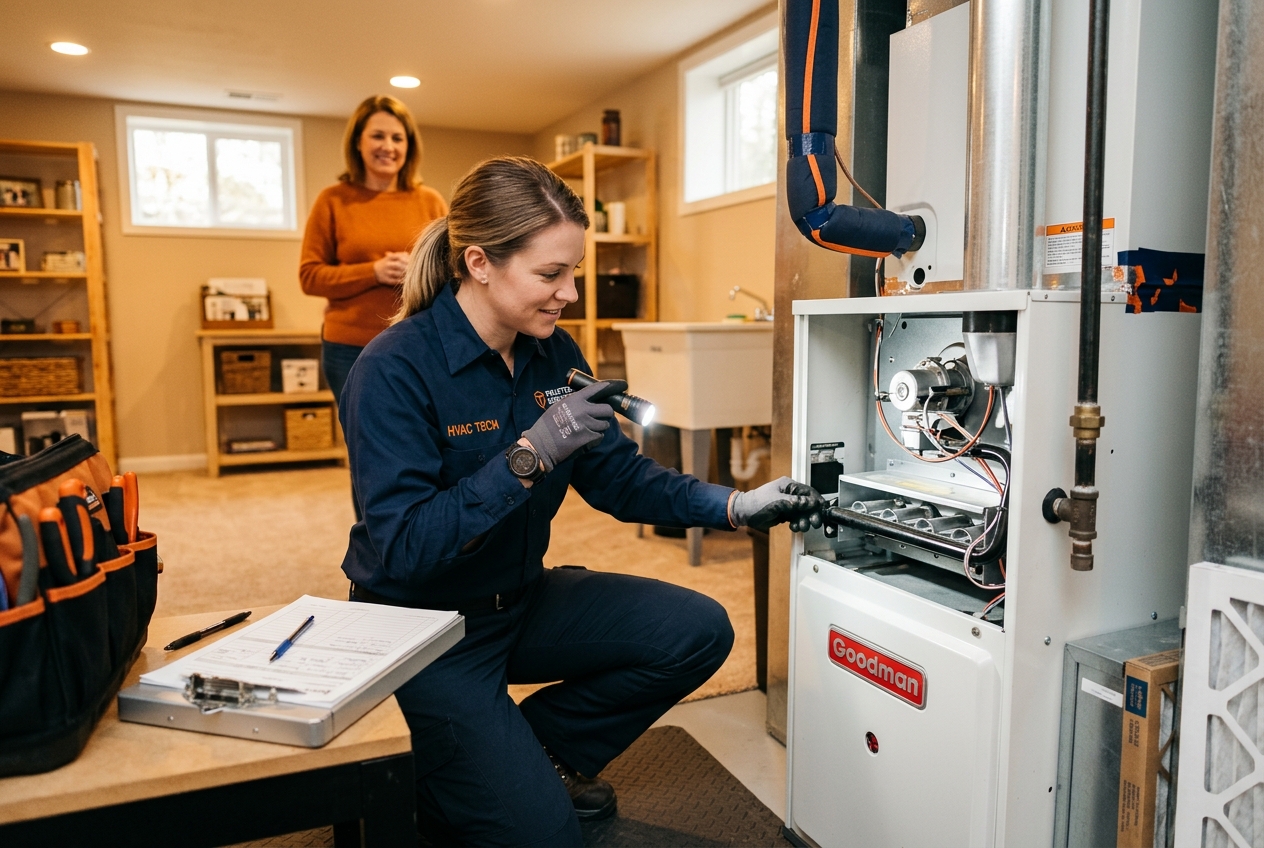
If your AC is running but not cooling the house, and the filter, thermostat, and vents all check out, it’s time to bring in a technician. The likely causes at that point involve refrigerant, the compressor, coil condition, or ductwork, none of which are safely handled without the right tools and certifications.
We serve Berks County and surrounding areas with fast, transparent HVAC diagnostics. No guessing, no upselling you a replacement when a repair will do. Contact Kodiak Comfort and let’s figure out what’s actually going on with your system.