
Nobody Thinks About Their Furnace in July. That’s Exactly the Problem.
Every October, the calls start coming in. The temperature drops for the first time, someone flips the heat on, and nothing happens. Or something happens, but it smells like burning and the homeowner doesn’t know if that’s normal. By mid-October, every HVAC company in Berks County is booked out a week or more. Wait times go up. Urgency goes up. And what could have been caught in August for the price of a tune-up turns into an emergency repair job.
We see this every single year at Kodiak Comfort. And every year, the homeowners who avoided that whole situation are the ones who called us in the summer.
Scheduling your furnace tune-up before winter in Pennsylvania isn’t just smart planning. It’s genuinely the better financial decision. Here’s why.
What Actually Happens During a Furnace Tune-Up
A lot of homeowners aren’t sure what they’re paying for when they schedule a furnace inspection. So let’s be specific.
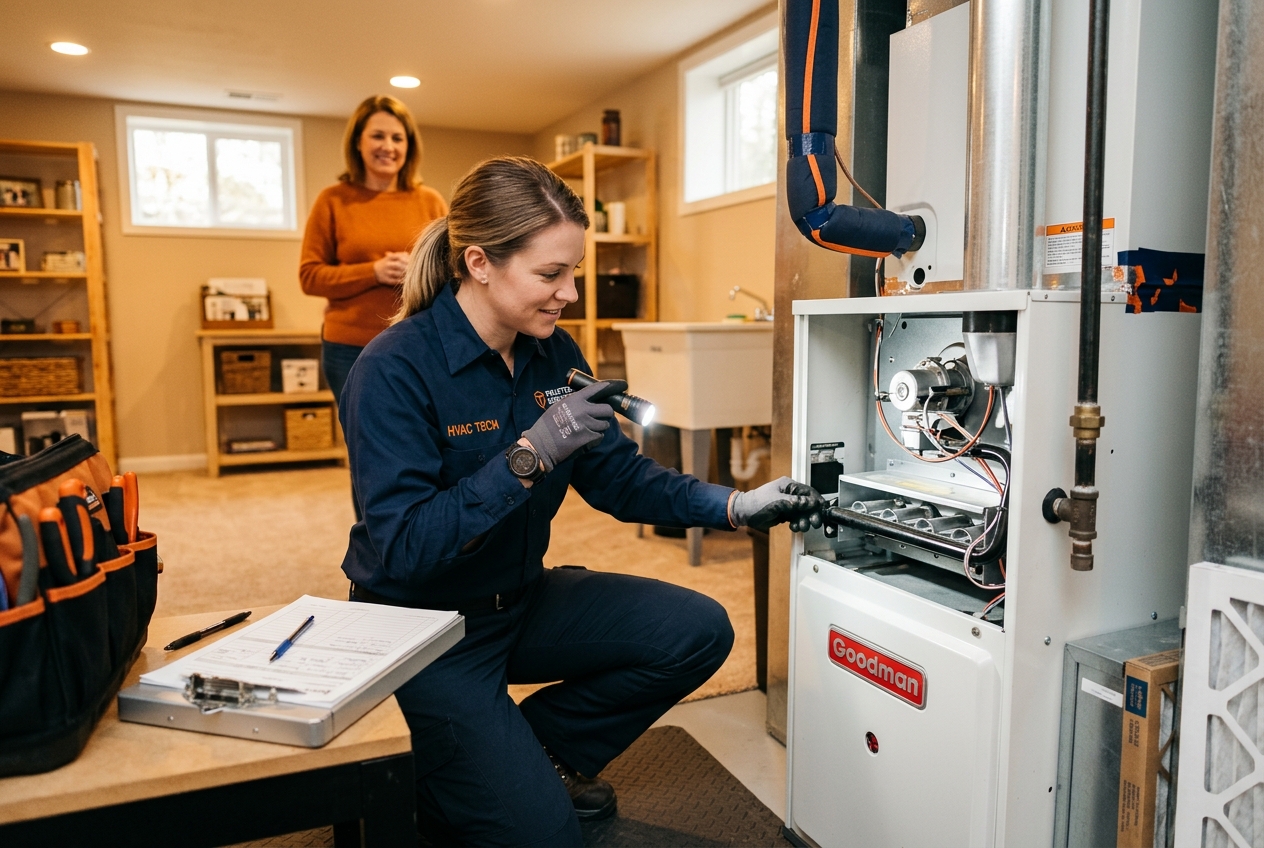
When one of our technicians comes out for a pre-season furnace tune-up, we’re checking the heat exchanger for cracks. That matters because a cracked heat exchanger can allow carbon monoxide to enter your home’s air supply, which is a real safety issue, not just a comfort one. We also inspect the igniter and flame sensor, clean the burners, test the blower motor, check all electrical connections, verify that the flue is clear, and test the system through a full heating cycle.
We replace the air filter if it’s due, test for carbon monoxide, and check the thermostat calibration. The whole process typically takes about an hour.
What we’re looking for are the problems that don’t announce themselves until the first cold night of the year. Weak igniters. Slightly restricted flues. Motors that are drawing more current than they should. These aren’t emergencies today. They become emergencies in November.
The Real Cost of Skipping It
People sometimes tell me a furnace tune-up feels like paying for something they don’t need yet. I get it. The furnace is working fine. It’s July.
But consider what the alternative looks like. A furnace that fails on a cold night requires after-hours service. Emergency diagnostic fees are real. If the repair involves a part that has to be ordered, you might be waiting for heat in January. And if the problem turns out to be a heat exchanger failure, you’re looking at either a major repair or a full system replacement, often on a timeline you didn’t choose.
The U.S. Department of Energy is clear that annual furnace maintenance extends system life, improves fuel efficiency, and catches safety issues early. Annual tune-ups are also often required to keep manufacturer warranties valid. Most homeowners don’t know that skipping maintenance can void coverage on a system that’s only two or three years old.
Summer Scheduling Is a Real Advantage
Here’s something practical. When you call us in July or August, you get to choose your appointment time. Morning, afternoon, a specific day that works for your schedule. Our calendar is open.
That same flexibility disappears by the last week of September. Fall is the single busiest season for HVAC companies in Pennsylvania. We’re doing installs, emergency repairs, and tune-ups all at once. We do our best to fit everyone in, but the reality is that availability gets tight fast.
Scheduling early also means that if we find something during the inspection, there’s no pressure. We have time to order a part, get back out, and fix it properly before you ever need the heat. That’s a completely different experience than a Friday-night emergency call in late October.
If you’re on our comfort maintenance plan, your fall tune-up is already included and we’ll reach out to schedule it. If you’re not on the plan yet, this is genuinely a good time to ask us about it.
Pennsylvania Winters Don’t Give You a Warm-Up Period
Berks County winters are not mild. We regularly see extended stretches below freezing, and the transition from fall to winter can happen fast. Some years we get our first real cold snap before Halloween. That’s not much runway between “thinking about scheduling a tune-up” and “the furnace needs to work tonight.”
Modern gas furnaces are also more complex than older systems. They have pressure switches, inducer motors, variable-speed blowers, electronic ignition systems. More components mean more potential failure points. An older furnace might soldier through years of neglect. A newer high-efficiency system is less forgiving. It needs annual attention to perform the way it was designed to.
If your furnace is between ten and fifteen years old, a pre-season inspection also gives us a chance to talk honestly about its remaining lifespan. We’d rather have that conversation with you in August, when you have options and time to plan, than in February when the system has just quit and you need heat by tomorrow.
What to Do Before the Technician Arrives
You can do a few things right now that make the inspection more productive.
Locate your furnace filter and check its condition. If you can’t remember the last time it was changed, it’s overdue. Check that the area around the furnace is clear of boxes, storage items, and anything combustible. If you have a gas furnace, take note of whether you’ve noticed any unusual smells near the unit this past year.
Also check your carbon monoxide detectors. If they’re more than seven years old, they should be replaced. The Consumer Product Safety Commission recommends CO detectors on every level of the home, and near sleeping areas. It’s a five-minute task that matters.
When our technician arrives, tell them anything you noticed last heating season. Short cycling, unusual smells at startup, uneven heat in certain rooms. That information helps us focus on the right things.
Book your furnace tune-up with Kodiak Comfort now, while the schedule is open. Berks County winters are not the time to find out your heating system has a problem. Summer is.